ClickPoint has expanded LeadExec's integration library and standardized how third-party compliance and validation services are configured, giving lead buyers a consistent setup experience that is enabled by lead type, scoped to specific campaigns, and executed automatically as leads arrive.
The integrations now available address the core categories lead buyers need at ingestion: consent documentation, contact verification, fraud detection, TCPA litigator screening, DNC compliance, and workflow automation. Each service is configured through a centralized Integrations page within LeadExec, where it can be enabled, mapped to lead type fields, and assigned to specific campaigns without custom development or external configuration.
Each integration screens for a different category of risk, and together they form a sequential validation process that can accept, reject, or flag leads based on configurable rules. Understanding what each integration checks and where it fits in the sequence helps lead buyers assess the quality controls their vendors are running.
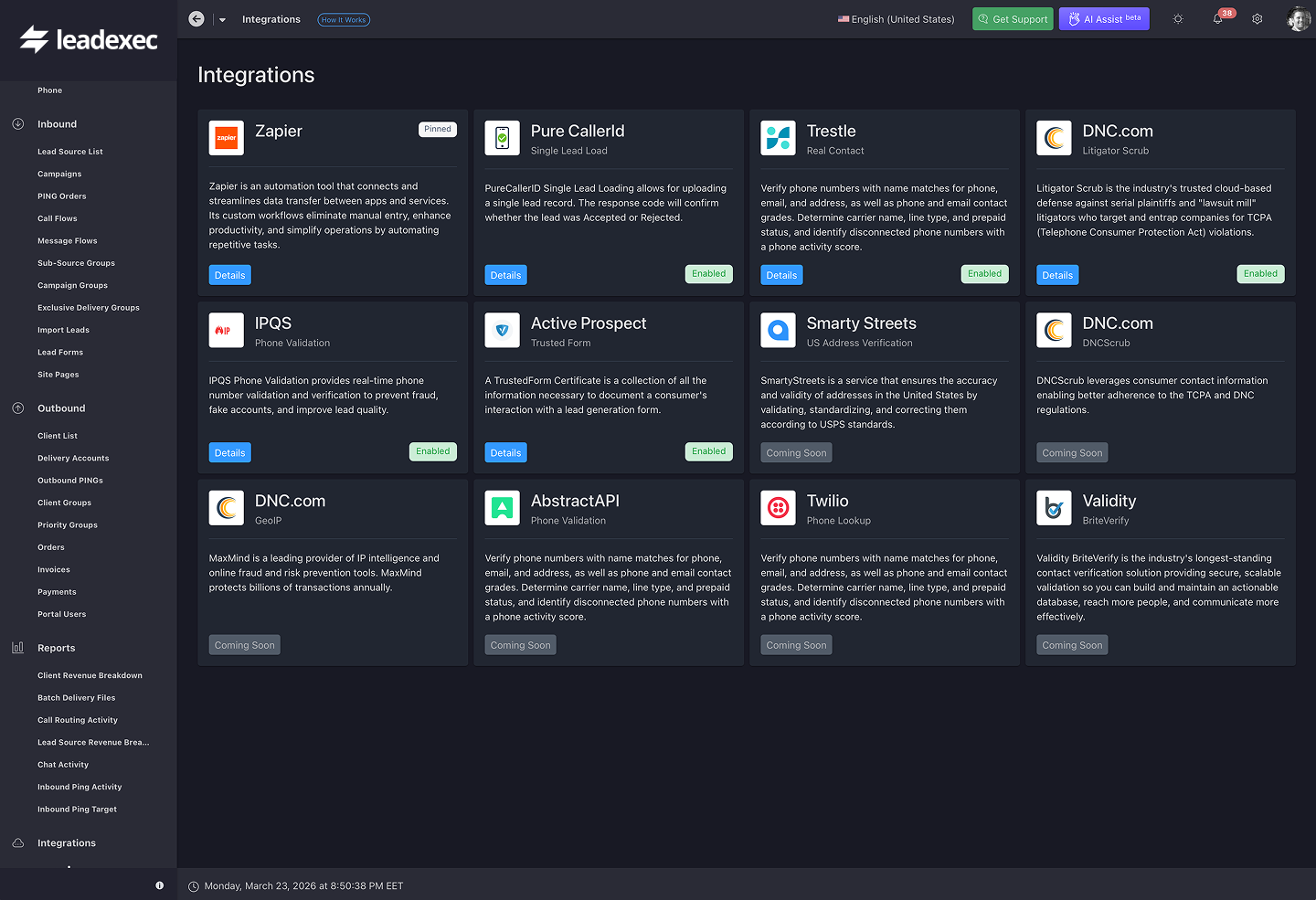
Consent Documentation: ActiveProspect TrustedForm
Before a lead is validated for contact quality, the foundational question is whether consent was captured correctly. The TrustedForm integration from ActiveProspect addresses this by creating a certificate at the moment a consumer submits a lead form. That certificate stores a record of what the consumer saw, how they interacted with the form, and when they submitted it.
Inside LeadExec, the TrustedForm integration verifies that the certificate URL submitted with the lead matches the contact information it was generated for, comparing phone and email against the values recorded at the time of capture. A mismatch signals that the lead data was altered or that the certificate belongs to a different consumer. LeadExec can be configured to automatically reject mismatched leads before they move further in the pipeline.
TrustedForm Insights adds behavioral data to the certificate, including geo-location, form input methods, and interaction patterns that distinguish genuine consumers from bot submissions. TrustedForm provides bot detection as part of consent verification, independent of phone number validation.
For buyers operating in TCPA-regulated verticals, the certificate also serves as a third-party consent record. If a contact disputes having opted in, the certificate documents what was presented to them and what they agreed to.
Identity and Contact Verification: Trestle Real Contact
Once consent documentation passes, the next question is whether the contact information is accurate and reachable. Trestle Real Contact validates phone numbers against the name on the lead record, returns associated address data, and provides line-type intelligence including carrier name, prepaid status, and a phone activity score that identifies disconnected or inactive numbers.
The name-matching capability is particularly relevant for lead buyers. A phone number can be valid and active while belonging to someone other than the person who submitted the form. When Trestle verifies that the name on the lead matches the name associated with the phone number, it adds a layer of identity confirmation that straightforward phone validation cannot provide.
Trestle also offers optional add-ons within LeadExec: an email age score, email deliverability check, and a TCPA litigator flag. Buyers who want a single integration to cover contact quality and litigator risk can configure Trestle to handle both.
Fraud Detection: IPQualityScore
Lead fraud takes forms that contact validation does not catch. A phone number can be valid, active, and name-matched while still belonging to a known fraud actor. IPQualityScore (IPQS) addresses this by analyzing phone numbers for fraud risk indicators that go beyond number validity.
The IPQS integration returns a numeric Fraud Score along with specific flags for VoIP lines, prepaid numbers, recent abuse history, and spam activity. LeadExec allows buyers to define threshold-based rules, rejecting leads above a certain fraud score, or routing leads with VoIP numbers to a quality control queue rather than automatic delivery.
The strictness level is configurable, which matters for high-volume operations where setting the fraud threshold too aggressively introduces false positives. IPQS also returns Do Not Call status as part of its phone analysis, though that check is not a substitute for a dedicated DNC compliance integration.
Compliance Screening: Pure CallerID
Pure CallerID performs a broader compliance pass than any single-purpose validation service. Within a single request, it checks number validity, line type, carrier details, prepaid and active status, national DNC registration, state DNC registration, and known litigator history.
The litigator check in Pure CallerID returns more detail than a binary match. The response includes the number of litigation hits, a description, and recommended actions, which gives compliance teams more context when evaluating flagged leads. For buyers purchasing in high-litigation verticals such as insurance, mortgage, and home services, this level of detail supports defensible decision-making.
Because Pure CallerID covers both DNC compliance and litigator detection in one call, it reduces the number of API calls required to run a full compliance check. That has practical implications for high-volume operations where per-call costs accumulate.
Targeted Litigator Screening: DNC.com
The DNC.com integration via Contact Center Compliance runs a focused litigator check that returns a single binary result: the phone number either appears in the litigator database or it does not. There is no scoring, no DNC coverage, and no line-type data. The integration does exactly one thing and does it at sub-second speed.
For buyers who already have DNC compliance covered through another integration, the DNC.com litigator scrub adds a lightweight, targeted layer specifically for serial TCPA litigators without the overhead of a full compliance pass. Because LeadExec allows buyers to configure integration order at the campaign level, the DNC.com check can be placed early in the sequence so that litigator-flagged leads are rejected before other, more expensive API calls are made.
Rejecting early on binary risk signals and running richer validation only on leads that pass is the core logic behind LeadExec's sequencing flexibility.
Workflow Automation: Zapier
Zapier connects LeadExec to external platforms through automated workflows that trigger without manual intervention. Buyers who receive leads from sources outside LeadExec's native integrations, including Facebook Lead Ads, web forms, or CRM systems like HubSpot and Salesforce, can use Zapier to route those leads into LeadExec for processing through the validation sequence before distribution.
Zapier also enables outbound workflows. Leads that pass validation in LeadExec can be automatically pushed to downstream systems, including sales dialers, CRM platforms, or notification tools like Slack. This removes the need to manually export and import lead data between systems.
How Integrations Work in Practice
LeadExec processes integrations in a configurable sequence at the campaign level. Each integration can be ordered independently, and individual integrations can be set to stop processing further checks when a rejection condition is met. A lead flagged as a known litigator by DNC.com early in the sequence will not proceed to Trestle or IPQS, which saves API costs without compromising the outcome.
Campaign-level overrides allow different validation rules for different lead sources or buyer requirements. As an example, a campaign serving insurance buyers in high-litigation states might run DNC.com first, followed by Pure CallerID for state DNC coverage, then Trestle for contact quality. A campaign focused on fraud prevention for an aggregator might weight IPQS more heavily. The configuration reflects the risk profile of the lead type and campaign, and buyers define the sequence based on their own priorities.
Frequently Asked Questions
What is the difference between the DNC.com integration and a full Do Not Call scrub?
Coverage is limited to known TCPA serial litigators; national and state Do Not Call registries require a separate integration such as Pure CallerID, which includes both as part of its validation response.
Can multiple integrations run on the same campaign?
Yes. LeadExec allows multiple integrations to run in sequence within a single campaign. The order is configurable, and each integration can be set to stop further processing when a rejection condition is met. This allows buyers to sequence faster, binary checks before more detailed validation to manage API costs.
What does TrustedForm verify that phone validation does not?
TrustedForm documents what happened at the point of consumer consent: what the form contained, how the consumer interacted with it, and whether the submitted contact information matches the certificate. Phone validation checks whether a number is valid, active, and compliant. The two serve different compliance functions and address different categories of lead risk.
How does IPQS differ from Trestle for phone validation?
Trestle verifies identity by matching a phone number to a name and confirming contact data accuracy across phone, email, and associated address data. IPQS focuses on fraud risk, analyzing a phone number's history for abuse patterns, VoIP usage, and a numeric fraud score. Buyers looking for identity confirmation use Trestle; buyers looking for fraud detection use IPQS. Both can run within the same campaign.
Does Pure CallerID replace the need for other compliance integrations?
Pure CallerID covers the broadest compliance scope of any single integration in the library, including national DNC, state DNC, and litigator detection. Buyers who want identity verification or behavioral fraud scoring will still benefit from Trestle or IPQS alongside it. Pure CallerID is a compliance tool; it does not perform the contact quality enrichment that Trestle provides.
