Sparkroom Alternative for EDU Leads
Discover why LeadExec is the top Sparkroom alternative for education leads. Compare features, compliance, and reporting to boost enrollment efficiency.
Consent and delivery issues in home services lead programs usually show up after leads are sold, not when they are captured. When consent records are fragmented or hard to reconstruct, buyers pause, return, or discount leads to manage risk. Programs with consistent capture, clearer records, and visible delivery health spend less time resolving disputes and more time scaling volume. Over time, that stability improves lead quality, acceptance rates, and cash flow.
In home services lead programs, consent usually becomes a problem after the lead is sold, not when it is collected.
A buyer goes to call or text and asks whether they are allowed to contact the consumer. If that answer is not obvious, the lead gets questioned or sent back. That can happen even when consent probably existed, but cannot be shown clearly or quickly.
When proof is easy to pull, the issue disappears. When it is not, it turns into email threads, credits, and delays, and those tend to drag on longer than anyone wants.
Over time, programs with cleaner consent records deal with less of that friction, while programs without them spend more time defending leads after the fact. That dynamic has more to do with how buyers manage risk than with any single regulation.
Ready to skip the theory and see a working flow? See LeadExec in action.
When buyers ask about consent, the discussion usually centers on whether the record can be reviewed quickly and held up later if needed.
That means being able to show what the consumer agreed to, when they agreed to it, and who the permission was for. When that information is clear and consistent, questions tend to end there.
Issues come up when parts of the consent record live in different systems. The form shows one timestamp, the affiliate payload shows another, and the exact language is not saved, or it is unclear which brand the consumer thought they were authorizing.
This tends to surface in programs running multiple lead sources or multiple buyers, where small inconsistencies compound quickly and show up later when a complaint or carrier inquiry comes in and buyers need to respond with confidence. If they cannot, the safest option is to pause, return, or stop buying from the source.
Over time, buyers learn which sources produce records they can rely on and which ones require extra scrutiny.
Consent usually breaks down because it is collected in pieces.
One tool captures the form submission, another stores a chat transcript, an IVR logs keypresses, and an affiliate sends a payload with its own fields and timestamps. Each part makes sense on its own, but none of them tell the full story.
When a lead moves through this setup, the consent record has to be reconstructed after the fact. That reconstruction is often imperfect. Small differences, such as timestamps that do not match, missing language, or unclear attribution, are enough to raise questions on the buyer side.
This is also where source-by-source exceptions creep in. One partner collects consent one way, another does it differently, and internal teams end up treating leads differently depending on where they came from. Over time, that inconsistency becomes hard to manage.
The result is not always outright rejection. More often, it shows up as friction, with slower reviews, more follow-up, and a growing list of edge cases that need manual handling.
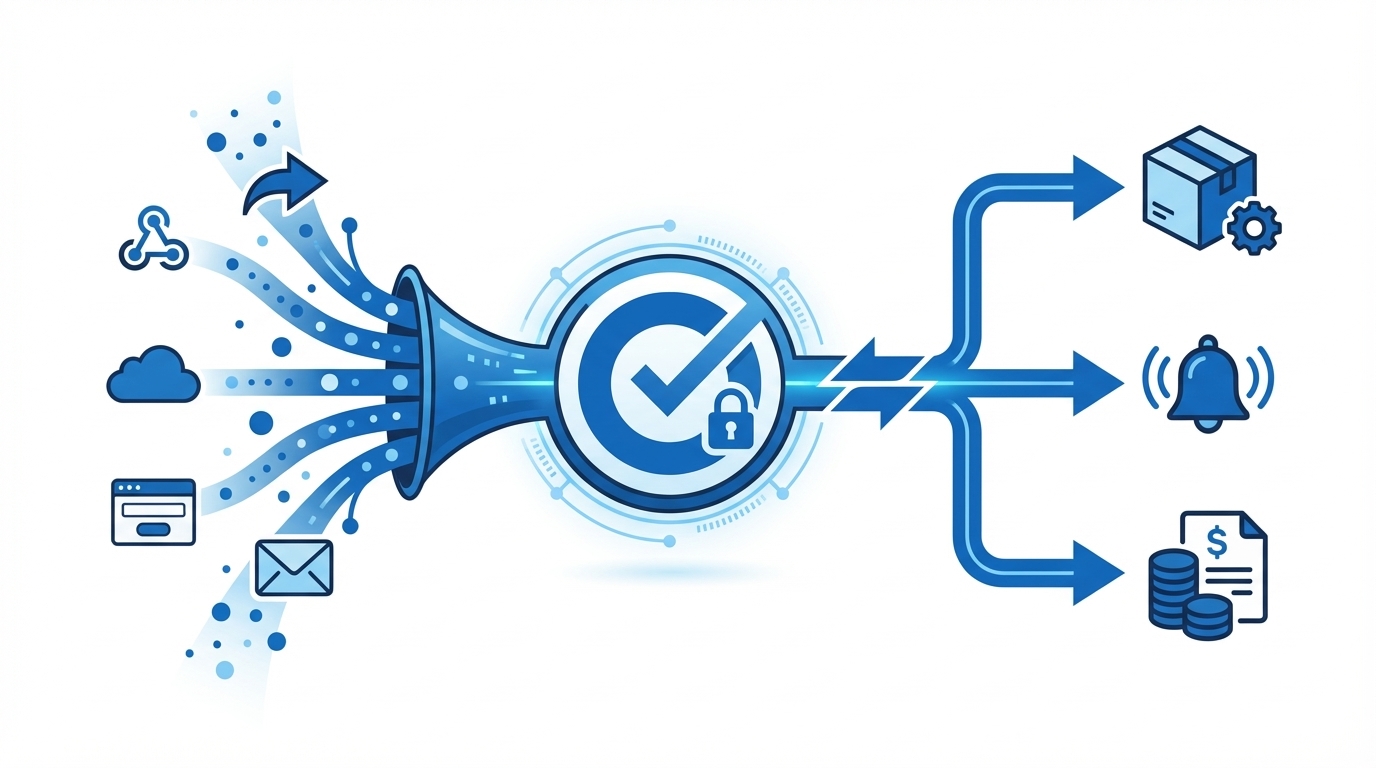
Centralizing lead capture does not change what consent is, but it does change how reliably it can be shown.
When intake flows through a single system, the same information is collected the same way every time. Consent language stays consistent, timestamps align, and source details are preserved rather than inferred later.
That consistency reduces the need to reconstruct anything after the fact, and when questions come up there is one record to review instead of several partial ones, which shortens reviews and reduces back and forth.
It also simplifies how teams work with partners. Instead of maintaining different rules and exceptions by source, the same requirements apply at intake, and leads that do not meet them never move downstream.
Over time, this shows up as fewer reviews, fewer returns, and less manual cleanup. That happens not because the rules are stricter, but because the process is clearer.
Once capture is consistent, downstream decisions get simpler.
Routing works best when eligibility is clear up front. If consent details are complete and coverage information is reliable, leads can be matched to buyers without extra checks or exceptions. When that information is missing or inconsistent, routing logic gets more complicated, and mistakes become more likely.
This tends to show up first in higher volume programs, where small inconsistencies get amplified as lead flow increases.
Returns follow the same pattern. Leads get sent back less often when buyers do not have to stop and verify basic details, and when they do get returned, the reasons are clearer and easier to address instead of turning into open ended disputes.
It also affects how programs scale. Adding new buyers or new sources is easier when the intake standard does not change, because the same assumptions hold and teams spend less time tuning edge cases after the fact.
None of this eliminates problems entirely, but it does reduce how many of them surface late, when they are harder and more expensive to fix.
Not all problems show up as returns.
Some leads fail quietly. A post times out, an endpoint rejects a payload, or a field changes and no one notices. From the outside, volume looks fine, but a portion of intent never reaches a buyer.
These failures are easy to miss because they do not trigger an immediate complaint, and instead surface later as lower acceptance rates, uneven pacing, or questions about why buyer numbers do not line up with delivery logs.
In setups without clear instrumentation, teams often find out after the fact. By then, the window to recover value has mostly closed, because the consumer has moved on and the lead cannot simply be resent.
Programs that track delivery health more closely catch these issues earlier. Errors get flagged when they happen, retries are possible while intent is still fresh, and persistent problems are easier to isolate.
Over time, this changes how reliable the system feels. There are fewer surprises, fewer questions about where leads went, and more confidence that what was captured actually made it through.
Most of the cost tied to consent and delivery issues does not appear as a single line item. It shows up in small losses spread across the program.
A returned lead here, time spent reviewing logs there, or a buyer pausing volume while something gets sorted out. None of those events are catastrophic on their own, but together they add friction and slow things down.
This is also where teams tend to underestimate impact. A few percentage points of avoidable returns or missed deliveries do not feel urgent day to day, but over a month or a quarter they compound into lost revenue and extra work that crowds out more useful tasks.
Reconciliation is often where this becomes most visible. When deliveries, returns, and invoices do not line up cleanly, someone has to dig through records to explain why, and the more fragmented the underlying data, the longer that takes.
Programs with cleaner capture and delivery records spend less time untangling these issues. The savings are cumulative and tend to show up as steadier cash flow and fewer interruptions.
Teams that spend less time dealing with returns, disputes, and reconciliation are usually not doing anything exotic. They have established a baseline that holds across sources and volume.
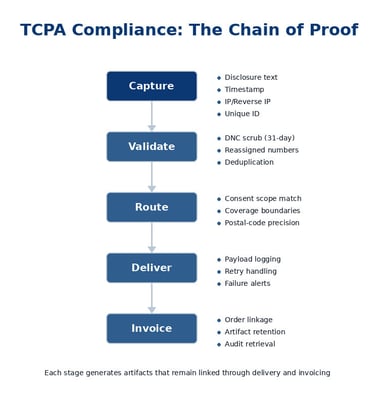
At capture, the same core information is collected every time. Consent language is consistent, timestamps and source details are recorded in one place, and coverage and basic eligibility checks happen before a lead moves on.
On the delivery side, the path from intake to buyer is predictable. When something fails, it is visible, and when a lead is returned, the reason is specific enough to act on without guesswork.
Most teams do not arrive at this all at once. It usually starts in response to friction, with one intake path standardized, then another, until the patchwork gets smaller.
Once that baseline is in place, adding volume becomes easier. New sources do not introduce new problems by default, and new buyers do not require custom handling just to get started.
Most teams do not set out to redesign capture and delivery. The decision usually comes after a pattern becomes hard to ignore.
Returns stop feeling occasional and start to feel routine, and a buyer pauses volume, then does it again for the same reasons. Reconciliation stretches out month after month, with more time going into explaining what happened than improving results.
At that point, the issue is no longer a single bad lead or a difficult partner. It is the system itself, with too many decisions being made downstream, when the cost of fixing problems is higher.
Teams that make the shift earlier tend to focus on where uncertainty enters the process. They look for places where consent details change by source, where delivery failures are not visible, or where proof has to be assembled after the fact.
The change is usually incremental. One intake path gets standardized, one exception gets removed, and one failure becomes easier to see and respond to. Over time, those changes reduce noise and free up attention.
The goal is not perfection. It is to spend less time reacting to avoidable issues and more time working on programs that already perform.
Most of the issues described here are not hard to spot once you know what to look for. They show up in returns that feel avoidable, in delivery gaps that take too long to explain, and in time spent cleaning up problems that should not have made it downstream.
None of that means a program is broken. It usually means the system has grown faster than its foundations, with capture expanding across tools and partners and small inconsistencies accumulating along the way.
Teams that step back and standardize how leads enter and move through the system tend to regain stability first, and fewer assumptions, fewer exceptions, and less reconstruction after the fact make lead quality easier to assess and outcomes easier to predict.
The goal is not to eliminate every issue. It is to reduce the number of problems that only become visible once they are expensive to fix.
When that happens, teams spend less time explaining past results and more time building programs that hold up as volume grows.
Why do consent problems show up after delivery instead of at capture?
Because buyers only need to verify consent once they try to contact the consumer. If proof is unclear at that point, the lead becomes a risk even if intent was captured correctly.
Is this driven by new regulations?
No. The patterns described here reflect buyer behavior and operational risk management, not a specific regulatory deadline.
What causes most consent disputes?
Fragmented capture. When timestamps, consent language, and attribution live in different systems, the record has to be reconstructed later, which introduces uncertainty.
Why do returns increase as programs scale?
Small inconsistencies that are manageable at low volume become harder to control as lead flow increases, especially across multiple sources and buyers.
What changes first when teams improve lead quality?
Fewer downstream reviews, clearer return reasons, and less time spent reconciling deliveries and invoices.
Still dealing with preventable returns and late-night surprises? Automate qualification and routing.


We’ll send you practical tips and ideas that we use ourselves and show you how to apply them to your sales and marketing workflow