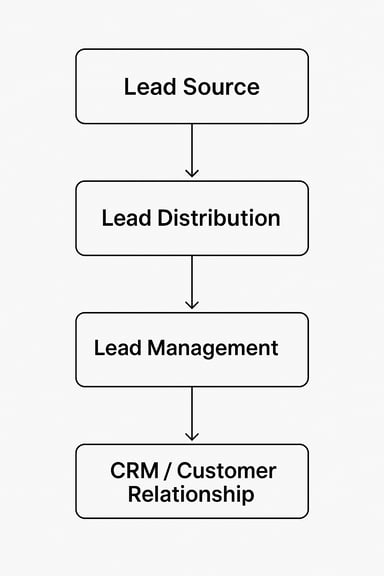
Lead Routing: Software and Best Practices
Automated lead routing is vital to lead generation, management, and distribution; improving response time, conversion rates, and sales performance.
It can be hard to even conceive of building a fast, reliable "good lead vs bad lead" scoring system without a heap of historical lead data.
Interestingly, not only can it be done, but there are real benefits to establishing a blunt scoring system early on. Waiting for complete conversion data before scoring leads costs revenue. Early scoring using intake signals and operational feedback can improve qualification accuracy as new campaigns stabilize.
The challenge shows up when a new campaign or lead source is added and there is no campaign-specific history to work from. Qualification often falls back to static rules, vendor scores, or manual review, even if there is plenty of data elsewhere in the system.
At the same time, decisions are already happening. Leads are accepted or rejected, calls connect (or they don't), and forms either pass validation or fail. These results happen quickly for most leads.
Cold-Start Lead Scoring builds models from operational signals available immediately (validation results, handling decisions, and early buyer responses) rather than waiting for complete conversion data to accumulate. It addresses the cold-start problem by learning from minimal data as real traffic flows.
Cold-start lead scoring works because useful signal appears long before conversion data does. By learning from validation results, handling decisions, and early buyer responses, it's possible to build and refine scoring models for new campaigns while real traffic is already flowing.
Every processed lead triggers decisions. It gets accepted or returned, worked quickly or ignored, booked or dropped.
Those decisions are enough to learn from. They show which leads move forward, which stall out, and where judgment is unclear. That structure exists even when a campaign is new and there is no deal history yet.
In ClickPoint's work across hundreds of lead distribution implementations, these early handling decisions consistently provide the first reliable signal for separating obvious cases from uncertain ones.
Learning from lead handling only works when decisions can be traced back to information present when the lead arrives.
Source, location, form fields, enrichment results, validation failures, and response timing are all available at intake, before any routing or follow-up happens.
Because that information is present right away, scoring models can begin learning without waiting for downstream results. This is what allows cold-start scoring to operate safely in production for new campaigns and sources.
With a few hundred hand‑verified examples and high‑precision signals like TCPA consent certificates, DNC status, and postal‑code coverage, you can put a guarded model behind your rules. It only approves when evidence stacks high. Everything else flows through your existing logic.
Most lead systems already contain rules. Some are explicit, like leads rejected for missing consent, invalid contact details, or known fraud patterns, or leads that fail validation at intake. Others are implicit, like sources that always get worked first or leads that are routinely ignored.
On their own, these rules are limited. They apply cleanly to some leads, fail on edge cases, and often remain in place even after lead traffic patterns change. But they still reflect real judgments made in the system.
In practice, these rules work best as weak signals. A lead rejected for bad contact information usually indicates lower quality. A lead routed to a senior queue often means higher value. A source that is consistently returned is less likely to produce workable leads.
When combined, those signals form rough training data. Some leads receive strong guidance, some weak guidance, and many none at all. That unevenness is expected, and it is sufficient for early scoring.
After roughly guided training, the model should be confident about some leads and uncertain about others. Some clearly score high, some clearly low, and a smaller set lands in between.
Leads in that middle band are where signals conflict or where similar cases are rare. Reviewing them adds information the model does not already have, while leads that are clearly acceptable or clearly rejectable move through without friction.
As this repeats, the middle shrinks, decisions sharpen, and performance improves without slowing intake or disrupting real buyers. This is how cold-start scoring becomes more precise without requiring broad manual labeling.
A new lead source starts sending a decent volume of leads, and the results are mixed. Some leads move cleanly, while others get returned by sales or sit untouched. There is no performance history yet, but lead decisions are already being made as the flow builds.
A simple scoring pass runs as leads arrive, separating obvious misses from leads that look workable. Most move through normal routing, while a smaller group collects for review in the middle, where follow-up and return behavior is inconsistent.
That middle group is where learning tends to happen. Reviewing a small number of those leads makes patterns easier to see over time. Missing fields, mismatched geography, timing issues, or quirks in the source begin to repeat, and those patterns feed back into scoring as weighted signals rather than fixed rules.
In LeadExec implementations, this stabilization typically occurs within two to three weeks. Fewer leads bounce back from sales, follow-up becomes more consistent on the right leads, and judgment is spent more carefully rather than more often.
The first iteration of the model should run fast, retrain easily, and fail in predictable ways, producing stable scores as leads arrive.
That usually means a model that trains quickly, can be updated often, and is easy to inspect when something shifts. When scores change, it should be clear why.
Speed matters as much as correctness. Scoring happens as the lead arrives, before routing or follow-up. A model that adds latency or fails unpredictably causes more damage than a slightly less accurate one.
Scoring fits into the existing lead flow. Scores are produced at intake, before routing or validation decisions are made.
The model runs on the same event that creates the lead and uses only information already present. If scoring fails, the lead continues down the existing path rather than stalling or dropping.
This keeps scoring additive rather than disruptive. It influences decisions when available and stays out of the way when it is not.
Scoring also changes how buyers experience new traffic. Obvious low-quality leads are filtered earlier, so good buyers see fewer bad leads during source testing and are less likely to lose trust before patterns settle.
Changes tend to show up first in buyer behavior. A buyer may start returning more leads than usual, hit caps faster with lower yield, or respond differently to the same source. Those patterns usually point to a traffic shift rather than a scoring failure.
In practice, this settles into a steady rhythm. A small set of returned or slow-moving leads from the middle band gets reviewed on a regular basis. When enough new decisions accumulate to change routing behavior, the model is retrained and thresholds are adjusted.
Because this scoring uses intake signals rather than long-term tracking cookies, it aligns with data minimization principles required by state privacy laws. This same monitoring mindset carries into validation and cost optimization, where small shifts in early signals often explain downstream efficiency changes long before revenue metrics catch up.
Early lead scoring works by shaping flow with the information already present. Day-to-day handling decisions provide enough structure to guide distribution, protect buyer trust, and improve lead quality while traffic is still new. Reliability builds as the system is used, not after perfect data arrives.
At ClickPoint our Customer Success team frequently sees our new LeadExec clients grappling with these issues. To see how LeadExec approaches lead distribution issues like this, sign up for a free account or book an informational demo.


We’ll send you practical tips and ideas that we use ourselves and show you how to apply them to your sales and marketing workflow